AI push notifications: what works and what the research says
What AI does for push, per published research: timing, content choice, writing and translation, a negative result included, plus a buyer's checklist.
Oricato Team Published 13 min read

You’re deciding whether to build or buy an AI feature for your push notifications, and every vendor page shows a big percentage with no method behind it. The published research gives a plainer answer. AI can help with four jobs (send times, choosing messages, writing copy, translating), and the best-documented tests show large gains in clicks next to small gains in daily active users. Nextdoor’s test went the other way: LLM-written push copy lost to the plain text it replaced.
Below: what each study measured, where AI goes wrong in a notification, and how to evaluate any AI feature, ours included.
Four jobs AI can do for push notifications
“AI for push notifications” covers unrelated techniques, each with its own risks.
Timing. A model predicts when each person is likely to respond and sends inside a window you set. This ranges from counting a person’s past sessions by hour to learned models that predict click rate for every slot in the day. Kuaishou’s TIM model, for example, splits the day into equal slots and allocates each user’s daily quota of notifications across them using predicted CTR per slot (Ji et al., 2024). Our guide to send-time optimization covers the mechanics.
Choosing content. Given a set of approved messages, a model picks which one each person sees. This is usually a multi-armed bandit: each template is an arm, and the system balances showing the current best one against trying others. Nothing new gets written, so the risk is low and the copy stays under your control.
Writing copy. A language model drafts the title and body, either per message or per person. This is where the “ai push notification generator” tools sit. It’s also where most of the failures in this guide come from, because the model can say things that aren’t true.
Translating. A model turns one approved English message into Spanish, German, Japanese, Hindi, Arabic and the rest. It fails quietly: an awkward phrase in Japanese won’t trip any metric you watch. We found no published randomized test of machine-translated push copy, so the evidence below covers the first three jobs. For the workflow side, see localized push notifications.
What the published research shows
The table lists every study we could verify from the paper itself. Tier A means a peer-reviewed paper reporting a production deployment or randomized online test. Tier B means an industry preprint or workshop paper that describes its method. Effects are relative changes as each paper states them, next to the population and metric they apply to.
| Study | Organization | Venue, year | Sample | Period | Metric | Effect as stated | Tier |
|---|---|---|---|---|---|---|---|
| Okoshi, Tsubouchi, Tokuda | Yahoo! JAPAN, Keio University | KDD 2019 | 382,518 users of the Yahoo! JAPAN Android app | 28 days | Click rate | “Maximum 60.7% increase”; compared with the previous system, not a stated control group | A |
| Yancey and Settles | Duolingo | KDD 2020 | Millions of daily reminders | Not stated in abstract | Total DAU; new-user retention | +0.5% total DAU and +2% new-user retention “over a strong baseline” | A |
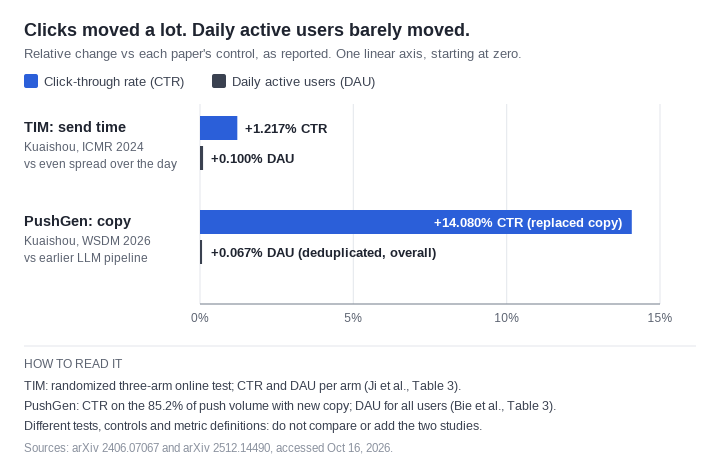
| Ji et al. (TIM) | Kuaishou | ICMR 2024 | Users split at random into three arms; size not reported | Not reported | CTR; DAU | Per-user timing vs even spread: +1.217% CTR, +0.100% DAU | A |
| Bie et al. (PushGen) | Kuaishou | WSDM 2026 | Production traffic; 85.2% of push volume got new copy | “Multi-day” | CTR on replaced copy; deduplicated DAU | +14.080% CTR on replaced copy; +0.067% DAU overall | A |
| Jobson et al. | Mercari | GenAIECommerce ’25 workshop (arXiv) | Over a million lapsed users, equal arms | One week, one email each | Item tap rate; open rate; buyer conversion | +23.63% item tap rate (significant); +0.46% open rate and −0.42% overall buyer conversion (both not significant) | B |
| Zeng et al. | Nextdoor | arXiv preprint, 2024 | “A small group” of users per push test | Read about one week in | Relative push open rate | Every GPT variant below control, from 86.26% to 94.09% of control’s open rate in experiment 2 | B |
Don’t average or add these effects; each has its own app, population, control and metric. And notice which column moves: where a study reports both clicks and an outcome, the click number is many times larger.
Timing: Yahoo! JAPAN and Kuaishou’s TIM
The Yahoo! JAPAN system used phone sensing and machine learning to estimate when each person was interruptible, and scheduled the push for that moment. Over 28 days with 382,518 users, the paper reports a maximum 60.7% increase in click rate and says the system went on to serve more than 10 million Android users (Okoshi et al., KDD 2019). Note the word “maximum”, the metric (clicks), and the comparison against the previous system.
TIM is the cleaner test for an outcome question. Kuaishou split users into three random groups: an even spread of notifications through the day (control), a group sent at the slots with the best overall CTR, and a group on per-user TIM timing. The same algorithm set every user’s daily quota in all three arms, so only timing changed (Ji et al., Table 3).
TIM raised CTR by 1.217% and DAU by 0.100%, both with p = 0.00. The group-slot arm raised CTR by 0.437% while its DAU change, +0.026%, had p = 0.37, so it wasn’t distinguishable from zero. Read on clicks alone, both arms look like wins.
Content choice: Duolingo’s bandit
Duolingo’s KDD 2020 paper is the reference for picking content. The authors built a “Recovering Difference Softmax” bandit to handle two problems that break textbook bandits for recurring reminders: novelty effects, where a fresh message does well because it’s fresh, and conditional eligibility, where some messages only apply to some people (Yancey and Settles).
Applied to millions of daily practice reminders, it produced a 0.5% increase in total DAU and a 2% increase in new-user retention over a strong baseline. That’s an outcome metric, against a tuned baseline, from choosing among messages that already existed. For most app teams it’s the most useful result here, and the least flashy.
Writing: PushGen and Mercari’s email titles
PushGen is the most detailed published test of LLM-written push copy we found. Kuaishou fine-tuned an 8-billion-parameter model on a corpus of over 70,000 past notifications, generated several drafts per video, and used a pairwise reward model trained on small A/B tests to pick the draft most likely to be clicked (Bie et al., WSDM 2026).
In the online test, CTR on the replaced copy rose 14.080%, the new copy covered 85.2% of push volume, and deduplicated DAU rose 0.067% overall (+0.196% for mid-active and +0.176% for low-active users). One detail matters a lot: the control wasn’t human copy. It was Kuaishou’s earlier LLM pipeline, DeepSeek V3 671B with retrieval. So this result says a tuned small model with a reward model beat a large prompted model, not that AI beat a copywriter.
Mercari’s test was email, not push, but it shows a click gain that didn’t reach the business metric. Over a million lapsed users got either a template title built from the first recommended item or a GPT-4o-mini title written from the same recommendations. Item tap rate rose 23.63% (z = 8.11), the open rate change was +0.46% and not significant, and overall buyer conversion moved −0.42%, also not significant (Jobson et al., Table 2). The authors say the emails boosted engagement but not the harder-to-move business metrics.
A negative result: Nextdoor’s LLM push copy
Nextdoor tried LLM copy for its “New & Trending” push, which sends one post a person may like. The control truncated the user-written subject and body and added “…”. The treatment used GPT to write a 3 to 4 word subject and a body of under 15 words (Zeng et al., section 3.2.1).
It lost every time. The first GPT version reached 87.89% of control’s open rate (p < 0.001); three body styles in the second test (extraction, first-person, question) reached 94.09%, 92.68% and 86.26%; a third round landed between 87.54% and 91.11%. The paper notes that GPT “hallucinated and did not always generate the subject lines as we wanted”, and that the closer the text stayed to the original post, the better it did.
The authors offer two explanations worth remembering. A tidy summary can tell people enough that they don’t need to open the push. And switching a neighbor’s first-person post to a third-person summary may have alienated users. Their email subject lines, by contrast, did win, but only after a reward model chose between the rule-based line and the GPT line: +1% sessions and +0.4% weekly active users, where the two GPT-only variants had lost 6.5% and 2.8% of sessions against the rule-based lines.
Where AI fails in notifications
A push is short, goes to many people at once, and can’t be edited after it lands, which makes the usual LLM problems worse.
- Claims that aren’t true. A model that invents a feature, a discount or a streak count sends that error to everyone in the segment. PushGen’s authors chose not to use reinforcement learning for now because a click-trained reward pulled the model toward salient names and numbers, “leading the model to learn reward shortcuts”, which they call “unacceptable in the push content scenario” (Bie et al., section 3).
- Tone. Nextdoor’s first-person to third-person shift is a tone failure, not a factual one, and it still cost opens. Your fitness app’s coach voice or your news digest’s neutral voice is a product decision; a model will drift from it unless you check.
- Brand terms and sensitive words. Mercari’s review of 1,000 sample titles found sensitive items slipping in, so the team added a filter that drops any item whose name matches a weekly-updated sensitive-word list. One of its screening examples is a title for a care walker, シルバーカー, which contains the string バーカ, a slang insult (Jobson et al., Table 3). Product names, trademarked terms and words your legal team has ruled out need the same kind of hard filter, plus a person to catch what string matching gets wrong.
- Language quality. The same Mercari review found repetitive phrasing, awkward item combinations, excessive length, incomplete words and “unnatural Japanese”. That was a model writing directly in Japanese; machine translation into Hindi, Arabic or Korean needs a reader who speaks the language for the same reason.
- Optimizing clicks over outcomes. Every model that learns from taps learns to get taps. TIM, PushGen and Mercari all show a large click effect next to a small or null outcome effect. A model scored on CTR can learn curiosity-gap phrasing that wins the tap and does nothing for the next week.
How to evaluate an AI feature
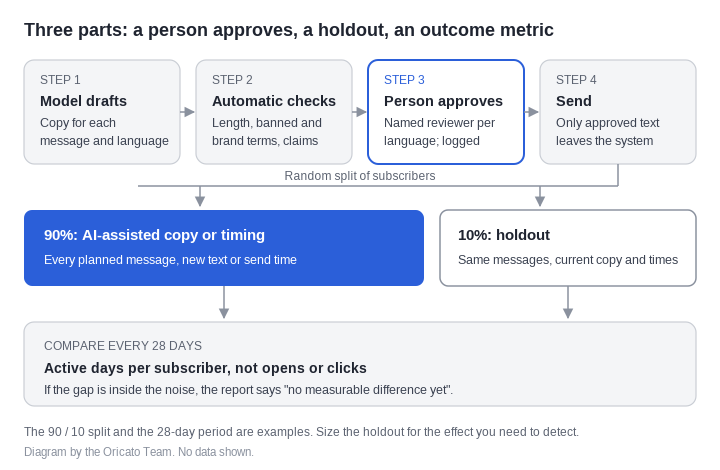
The stronger studies above share a design: random assignment, a control that gets the same messages, and a metric beyond the click. You can run it on any AI feature, bought or built.
Holdout and outcome metric
Keep a random slice of subscribers on your current copy and times, with every planned message, for months. Compare the groups on an outcome such as active days per subscriber in each 28-day period. Report clicks too; just don’t let them decide. Our guide to holdout groups for push notifications covers sizing, and push notification metrics covers which numbers to trust.
Run it long enough to get past the novelty bump. In an industry workshop of 26 experts from 15 online platforms, most participants agreed that the size of a treatment effect commonly shifts after the first few days of an experiment, and the paper concludes “there is no substitute for a well-run long-term experiment” (Sigerson et al., 2026). Duolingo built novelty handling into its bandit for the same reason.
Size matters too. TIM’s +0.100% DAU was measurable on Kuaishou’s audience; on an app with 20,000 subscribers it’s far below what any test can detect, so a null result there is expected and should be reported, not hidden.
Human approval and audit trail
For copy and translation, a person who speaks the language approves each draft before it can be scheduled. Google’s guidance for AI-written web pages makes the same point for a different medium: generative models “predict a likely sequence of words”, so it’s “critical to manually factcheck and review all AI-generated content” before publishing (Google Search Central, last updated Oct 1, 2026). A push to your whole German audience deserves at least that.
Mercari’s process shows what thorough looks like: three review rounds on 1,000 sample titles, sign-off from trust and safety, marketing, branding, legal, security, IP and AI ethics teams, and a note in every email that the title was AI-generated (Jobson et al., section 3.5). A small studio won’t have seven teams, but it can log the same facts for every message: the draft, the model and prompt version, the automatic checks it passed, who approved it, when, and in which language.
Cost controls
LLM cost grows with the number of generations, so the design choice that matters most is what you generate per. Writing per message and per language is bounded: a fictional recipe app with 3 daily messages in 10 languages needs 30 drafts a day. Writing per person multiplies that by the audience, and 3 messages for 200,000 people is 600,000 generations a day, each one a new chance for an error nobody reviewed.
Nextdoor’s controls are a practical template. Every project that called the OpenAI API had to check in a config with the experiment name, owning team, expected cost and budget, expected queries per second and max output tokens; they kept a blocklist to shut an experiment down on the fly, and caching cut both tokens and rate-limit errors (Zeng et al.). Model size is a lever too: Kuaishou moved push copy from a 671B-parameter model to a fine-tuned 8B one, while Mercari found a local 3B model’s titles “rather bland”. Test the smallest model that meets your bar.
Questions to ask a vendor
Bring this list to any AI feature demo. It applies to every vendor, us included.
Buyer’s checklist: AI notification features
- Which job is it doing? Timing, choosing among approved messages, writing new copy, or translating? Each has a different risk.
- What’s the control? A randomized holdout that gets the same messages, or “before we turned it on”? Only the first is evidence.
- Which metric decides? Ask for an outcome (active days, retention, purchases) and the click metric from the same test.
- How long, and how big? How many 28-day periods, how many users, and what’s the minimum detectable effect at my audience size?
- What does a null result look like? Will the report say “no measurable difference”, or does it only show lifts?
- Who approves the text? Can anything reach a user without a person approving it, in each language?
- What gets logged? Draft, model version, prompt version, checks passed, approver and time, exportable.
- What data goes to the model provider? Message text only, or user identifiers and behavior too?
- What’s the cost ceiling? Is there a hard monthly cap, and what happens when it’s reached?
- Where does the uplift number come from? Which test, which metric, which control, how many users, and is it theirs or a customer’s?
For the writing workflow in detail, see writing push copy with an LLM and our guide to machine translation for push notifications.
What Oricato does here
Oricato Intelligence · Early access. Designed and in development. No results yet.
Today, Oricato sends mobile push at each person’s local time and in their language, with Sent, Delivered and Opened receipts. Oricato Intelligence (early access) is designed around the evaluation method above:
- Timing and content tests against a holdout, measured in active days per subscriber, with a look every 28 days.
- Drafts and translations for people to approve. The AI writer and AI translation (both early access) produce drafts only; a named reviewer per language approves before anything is scheduled.
- Code first, AI optional, with a hard monthly budget cap, and no personal data sent to the AI provider.
- Pooled across a studio’s own apps, never across customers, which is the realistic route to a measurable answer for small apps.
- Honest readouts. “No measurable difference yet” is reported as exactly that.
Early access · launching soon. Request early access, or follow the build in the newsletter.
Sources
It is based on the papers and documentation below, each re-opened on Oct 16, 2026; numbers are quoted from the papers’ own tables and abstracts. The Duolingo figures come from the paper’s abstract. The diagrams were drawn by the Oricato Team; the chart uses only the values the papers report.
- Okoshi, Tsubouchi and Tokuda, Real-World Product Deployment of Adaptive Push Notification Scheduling on Smartphones, KDD 2019, DOI 10.1145/3292500.3330732, accessed Oct 16, 2026
- Yancey and Settles, A Sleeping, Recovering Bandit Algorithm for Optimizing Recurring Notifications, KDD 2020, DOI 10.1145/3394486.3403351, accessed Oct 16, 2026
- Ji et al., TIM: Temporal Interaction Model in Notification System, ICMR 2024, DOI 10.1145/3652583.3657614, arXiv v1 (Jun 11, 2024), accessed Oct 16, 2026
- Bie et al., PushGen: Push Notifications Generation with LLM, WSDM 2026, DOI 10.1145/3773966.3779373, arXiv v1 (Dec 16, 2025), accessed Oct 16, 2026
- Zeng et al., Large Language Models for Social Networks: Applications, Challenges, and Solutions (Nextdoor), arXiv v1 (Jan 4, 2024), accessed Oct 16, 2026
- Jobson et al., Using item recommendations and LLMs in marketing email titles (Mercari), GenAIECommerce ’25 workshop, arXiv v3 (Sep 21, 2025), accessed Oct 16, 2026
- Sigerson et al., Evaluating for the Long Term: Learnings from Industry, arXiv v1 (Aug 8, 2026), accessed Oct 16, 2026
- Google Search Central: Google Search’s guidance on using generative AI content on your website, last updated Oct 1, 2026, accessed Oct 16, 2026
Keep reading
All guides
Send-time optimization explained, and how to test it
How send-time optimization models work, why they can learn your own schedule back, the cold-start problem, and the one test that shows if it helps.
Holdout groups for push notifications: measure real lift
Use a holdout group to learn whether push changes behavior: pick the outcome metric, size and duration, keep it clean, and read the result honestly.